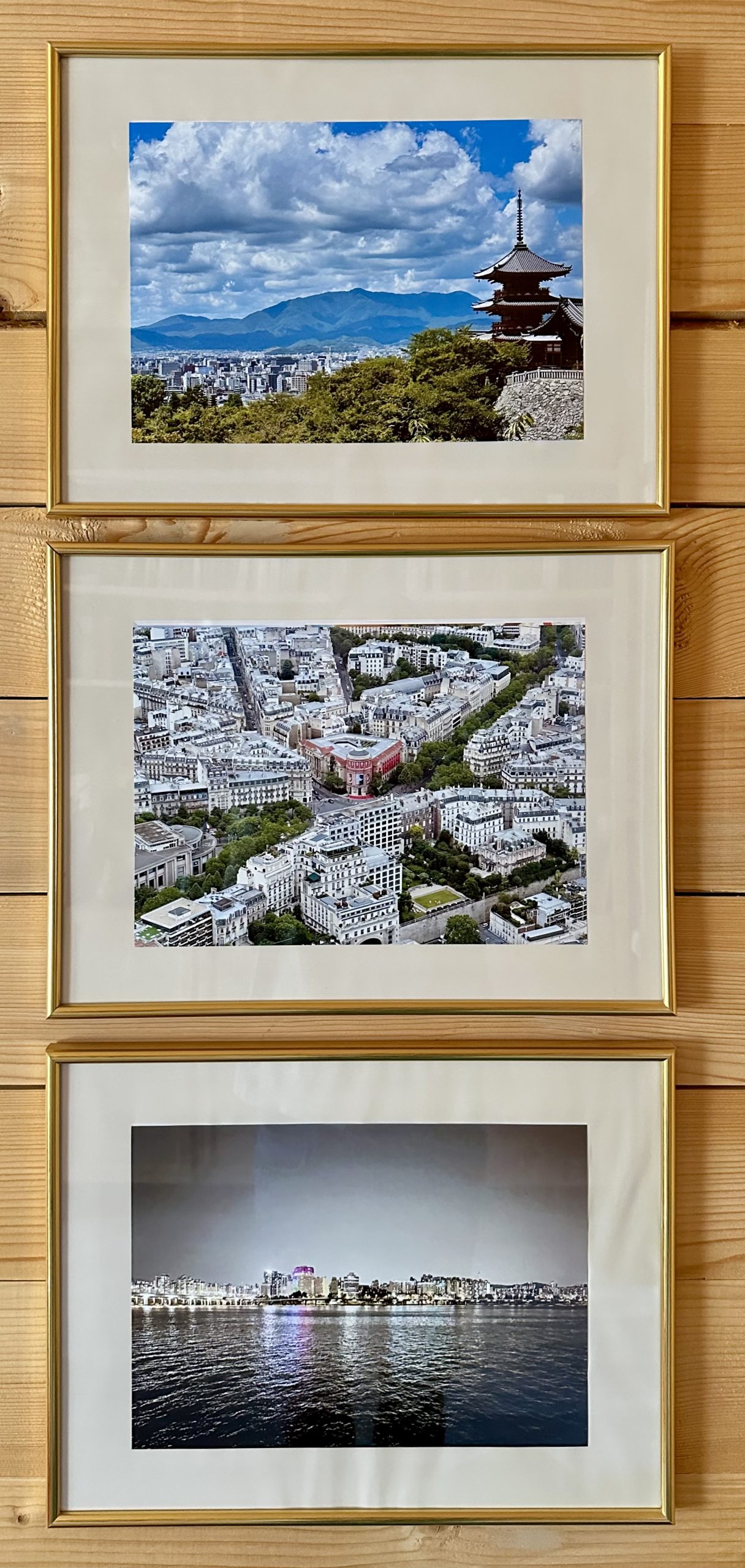
I took these three photos in one summer, on three different trips. Then months later I bought an ink printer for full bleed prints, went through a few hundred photos, picked three, framed them, and hung them on the wall in whatever order looked good. That was the whole event. No concept, no story. Top, middle, bottom.
Top is Kyoto by day. The pagoda at Kiyomizu-dera, the city, the mountains, a sky doing something I've only seen the sky in Kyoto do. The pagoda, in Buddhist architecture, is a stylised stupa: the axis between earth and heaven.
Kiyomizu-dera · the axis between earth and heaven
Middle world · Paris from above
The middle one, I took from the Eiffel Tower, looking down into the mesmerizing labyrinth. There's a building in the centre of it, bright red . I thought it was a nice splash of colour.
Turns out the red splash is the Musée Guimet. The national museum of Asian arts. It sat between Japan and Korea on my wall for months before I bothered to search what that red building was.
The red on the façade was an artwork. For the opening of the Year of China, the Guimet let a Shanghai artist, Jiang Qiong Er, cover the entire façade in a red veil and turn it into a set of grottoes with fantastical creatures living in them. The piece was called L'Origine and it was up from April 2024 to February 2025 (Museum TV). L'Origine reminds me of this post:
Gods always start at the top of your forehead. The most abstract ideas and the most incomprehensible concepts are at the basis of all religion: Chronos (time), Brahman (space), The Word (consciousness).
Then they get lower and lower.
They deprecate, they decay, and are finally brought to a more human level of understanding. In the end it's all about basic instinct such as survival, reproduction or the natural love for our offspring: Jesus, Krishna or Hercules.
So the middle frame is a Chinese artist's piece wrapped around a French museum of Asian art, hanging between a Japanese temple and a Korean skyline. I had a triptych of East Asia and didn't know it.
Jung called this synchronicity. The universe does have a way to order itself in amazing ways sometimes.
I think there's a sense of all connectedness that people keep noticing and keep tiptoeing around.
The labyrinth · a red splash at its centre
Lower world · Seoul by night
Bottom is Seoul by night, shot from the Han river. Crisp air, living city, late summer life in Yeouido Hangang Park. Dark water with the skyline lights reflected upside down in it, moving into an abyss.
Upper world. Middle world. Lower world.
Upper world. Middle world. Lower world.
Just so happens the arrangement is all too human. That layout is more or less universal. Yggdrasil, the Mesopotamian heaven, earth and underworld, the Egyptian Duat, the Vedic triloka. People with enough mind to build mind boggling temples and run empires longer than any country alive today believed there was an above and a below, and they weren't stupid. Jung's late name for the one world underneath psyche and matter was unus mundus, and he buried it, named it in Latin, placed it in an 800 page book about alchemy.
The modern reflex is to bring all of that indoors and call it the unconscious, or neurons, or a function. I think that's modern spleen at its worst.
Unus mundus
The universe has a way to order itself in amazing ways.